
Night Of The Museums
When opportunity knocks, it´s usually worth taking. On returning from Sydney a little under two months ago, I joined Tarragona´s most popular gym, for the obvious benefit of fitness – but also for the social life that comes with being in a large group of people. Then, when the gym´s calendar of social events for May advertised a free, guided tour of Tarragona´s museums and historic sites, I put my name down straight away.
In my four years of living in Tarragona, I´ve had a cursory glance at most of the historic sites and some of the museums. But I had never properly inspected our (I now see myself as a local)….our amazing Roman amphitheatre which dates from the 1st century AD. I spent an hour or so there before our guided tour began at 8.00pm. (For those interested, I wrote a post on April 10 which gives considerable detail about Tarragona´s Roman history).
Also, by way of further background, this Night of Museums was part of International Museum Day which has been held on or around May 18 each year since 1977. At these annual events, thousands of cities and towns around the world throw open their museums and places of interest free to public. I went to one in Barcelona about 15 years ago and it was fabulous, with hundreds of thousands of people roaming the streets and dropping into fascinating museums which they had previously walked right past countless times. The theme for this year´s International Museum Day was “2026 – Museums Uniting A Divided World”.
Our tour began in La Plaça de la Font which is in the centre of the ancient part of Tarragona. Juan, our guide, explained that it was on this very spot that the Tarragona´s famous circo romano existed (visualise….the Circus Maximus in Rome). In fact, as I already knew, the location and dimensions of the circo romano are clear for all to see because there are still so many well-preserved ruins. Parts of the tiered, spectator grandstands along one side of the track remain in good condition. And most of the turning curve and the spectator seating at one end of the track are visible too. All of them are just sitting there in the Tarragona sunshine as they have done since they were built in the 1st century AD. The entire structure measured 325 metres long by 115 metres wide. One of the amazing things about this historical site is that the modern-day surface of La Plaça de la Font is at the same level as the original dirt track of the circo when, in its heyday, the chariot drivers were cheered on by the capacity crowd of 30,000 people. It´s easy to stand on that spot and hear history all around you.
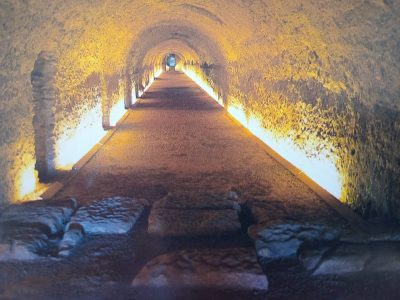
But it is beneath the circo where the whole thing becomes staggering. Knowing that the immense weight of the grandstands would require sturdy foundations, the Roman engineers built a series of arched vaults along the length of the structure: before putting the track and stands on top. These subterranean tunnels, some parts of which are still accessible, had other purposes as well. First, they served as circulation corridors for staff and competitors. Also, much as we see in modern-day sporting venues, the Roman spectators walked through the vaults then up internal stairwells which led them to their designated seating areas in the stands above.
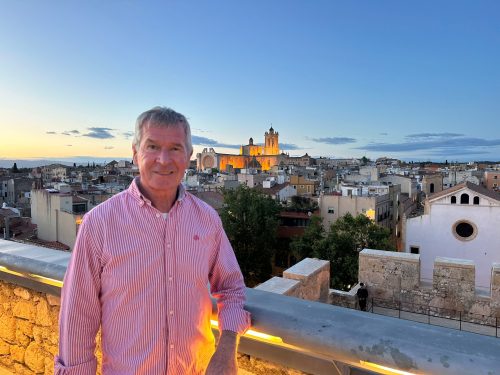
These days, access to the vaults is through a tower called the Praetorium. In Roman times, this building housed one of the two enormous stairways that allowed people to move between the terrace of the circo and Tarraco´s open forum. Juan told us that in medieval times the Praetorium was fortified and turned into the castle of the Princess of Tarragona, and was later the city’s royal residence. The rooftop of the Praetorium offers stunning views across all of Tarragona. Juan´s tour duration of an hour and a half gave us only a glimpse. So, my full understanding of Tarragona´s history remains a work in progress.
Fun fact. Or, as is often the case with history….here´s some information which it is fun to believe. The highest paid athlete in all sporting history is a Roman charioteer who raced many times at Tarragona´s circo romano. His name: Gaius Appuleius Diocles. In a career spanning 24 years, which included winning 1462 of the 4257 races he contested, Gaius won prizemoney of just over 35 million sesterces (the currency of the day). That equates to roughly US $15 billion in today´s money. Modern websites will tell you the basketballer, Michael Jordon, is the most richly rewarded athlete of all time. Sorry, not true, big fella. In fact, with a paltry US $4.5 billion, Jordan isn´t even in the same league as our Gaius, who was born in Lusitania in Spain, but completed mainly in Rome. Mind you, unlike Jordan, Gaius died aged 42, one year after retiring from racing.


Success doesn´t come from what you do occasionally, it comes from what you do consistently.