
In The Footsteps Of Tarragona´s Romans
If you had a time machine, would you go forwards into the future or backwards in time? I´d go backwards, as I do every day when I am surrounded by the extraordinary Roman ruins in Tarragona. Whenever I go shopping in the centre of town, I walk along some of the very same streets the Romans built and used all those years ago. Even after four years of living here, it still thrills me. So, please, indulge my wide-eyed wonderment as I focus on a few of my favourite parts of this historic town.
Let´s begin with some background history. The First Punic War was fought on the Iberian Peninsula between the Carthaginians and the Romans from 264 to 241 BC. Rome won that war. (Remember, the Carthaginian empire occupied much of northern Africa and was now extending into modern day Spain).
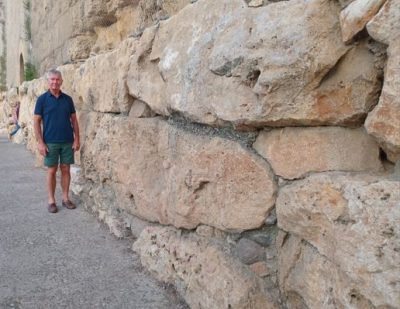
Twenty or so years later, in 219 BC, the famous Carthaginian army general, Hannibal, sacked the town of Saguntum, near Valencia in Spain. This pissed off the Romans no end and they declared war once again on Carthage. Thus began the Second Punic War. Undaunted, in 218 BC, Hannibal and his elephants marched over the Pyrenees mountains in Gaul (France) en route to Rome, which he hoped to vanquish. As a tactical measure, Rome immediately sent a force to Spain with intention of cutting off Hannibal´s supply chain, or indeed his retreat route if he gave up on Rome. That force, led by Gnaeus Cornelius Scipio in 218 BC, defeated a Carthaginian army which was encamped at Tarraco (modern day Tarragona). The following year, Publius Cornelius Scipio joined his brother in Tarraco and they set about fortifying and developing settlement. That was almost exactly 2200 years ago and some of the initial, gigantic stones they placed in the defensive wall are still there for all to see.
In 46 BC, the Roman commander Gaius Octavius spent a few months in Tarraco and liked it very much. His great uncle was Julius Ceasar, after whose death, Octavius was promoted and renamed in 27 BC as Augustus, the first emperor of the Roman empire. He left Rome almost immediately and relocated to Tarraco for the years 26 and 25 BC, ruling the empire from just up the road from my place. It was during this time that Augustus declared Tarraco would become a symbol of Rome´s magnificence. Thus, a remarkable period of construction saw Tarraco indeed become the most powerful, opulent and wealthy Roman city on the entire Iberian peninsula. It was of far greater significance than Barcelona, for example. For a more comprehensive history of Tarragona, here´s an official website.
The funny consequence of the impact Augustus had on Tarraco is that his name is everywhere to be seen in modern day Tarragona. Café Augusta, Hotel Augusta, Augusta Dry Cleaners, Augusta Real Estate, Bar Augusta, Augusta Fruit & Veg, Mobile Phones Augusta, etc, etc. Legend has it that his last words before dying in 14 AD were: “Have I played the part well? Then applaud as I exit”. Well, here in Tarragona they are still applauding you, old friend. The most prominent reminder of all is Via Augusta. This was the road which ran from the centre of town northwards along the coast. It is reasonable to presume that the current Via Augusta follows the very same route as the initial road took 2000 years ago. We know this for two reasons. First, the corridor between the sea and the hills is only 500 metres wide in many places. Second, located about 4km out of town is a funerary monument historically (but erroneously) believed to contain the bodies of the Scipio brothers. An ancient Roman law prohibited burials within the city. This led to roads into and out of the city being lined by funerary monuments of the elite, as a form of family propaganda. The Scipio monument sits right beside the current day Via Augusta. I travel along Via Augusta virtually every day – and it excites me to contemplate the countless generations of soldiers, traders and people who have trodden this same path.
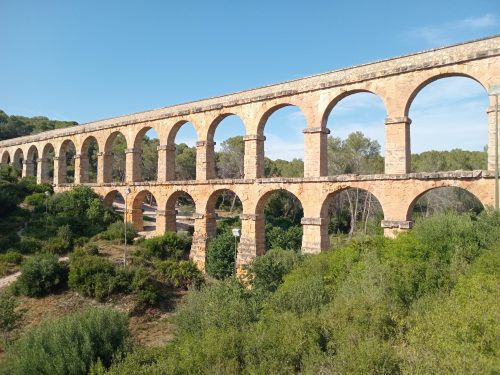
“What have the Romans ever done for us?” the Monty Python crew asked. Well, engineering, for a start. In the 1st century AD, two long aqueducts were built to supply Tarraco with running water. The first, known as Aqua Augusta, was fed by the Gaià river and was approximately 50km long. The second, Les Ferreres, brought water from the Francolí river, 15km to the north of the city. The most spectacular surviving stretch of the Les Ferreres aqueduct is just beyond the present-day city limits and is popularly known as the “devil´s bridge”. It is 217 metres across and 27 metres at its highest point. It has an upper section of 25 arches, and a lower section with 11 arches. The entire bridge was built without the use of mortar.
To stand at its base is to marvel at how precisely the stone blocks were hewn; to wonder how on earth they got them there; to be in awe of the engineering feat from 2000 years ago; and to simply be amazed and grateful that such a thing of beauty is still standing. Nowadays, the public is allowed to walk across the bridge – thus, truly in the footsteps of Tarragona´s Romans.
Tarraco / Tarragona has a sea-faring history stretching back several thousands of years. Initially a fishing village, it then transformed into a thriving Roman port which saw soldiers and traders set forth to all parts of the Mediterranean, including a busy shuttle service between Rome and Tarraco. These days it is one of Spain´s most important sea ports. When I arrived in Tarragona, I lamented the sight of the somewhat-ugly, modern-day commercial vessels at anchor just off the coast, awaiting entry to the port. However, I found peace when I became acquainted with the Roman history and realised the ships I see now are just the current versions of millennia of boats coming and going from this ancient city.


The best way to predict your future is to create it.