
Travelling Solo In Southern Portugal
I am standing alone at the water´s edge of a beach on Portugal´s south-western coastline, and Mother Nature has me under Her spell. The weather is fine and the Atlantic Ocean is not angry – though it´s fully alive – and is producing a rhythmic sequence of wave after wave. I watch as energy grows in the green-blue sea a few hundred metres offshore, creating the start of a wave, which gathers in bulk and goes paler in colour as it draws nearer to me. Then, with a sudden shallowing of the water beneath it, the wave grows impatient and rises to a vertical wall of perhaps four metres in height; at which moment the full length of its crest breaks into white foam and cascades over in front of itself, producing a thunderous sound as the whole ensemble explodes into a chaos of energy, bubbles and water, now tumbling in a line towards me. I am imbued with the sound of Nature at work and the salty smell of the ocean as the wave – its power now spent – quickly surrenders all shape and form. By the time it slides up the angled beach to tickle my toes it is nothing more than a ripple of transparent water. Then, like a cowering foe, it retreats to whence it came, being enveloped by the sand on its way. I look back up to the ocean and see an endless supply of waves in that same cycle of rise, fall and fizzle.
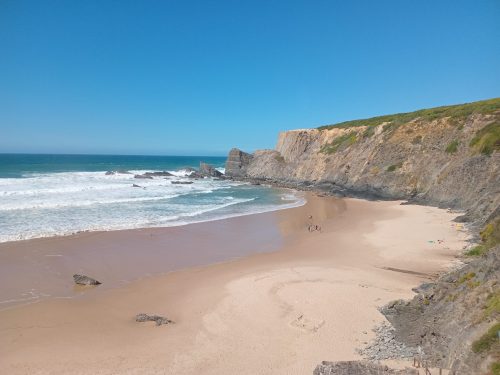
Barely the length of a football field, this beach has imposing cliffs behind it and rock formations at either end, which look hard, sharp and menacing. These rocks, which proliferate along the Portuguese
coastline, are carboniferous turbidites. Geologists say they consist of alternating layers of shale, graywacke and sandstone; and were formed more than 300 million years ago in deep-sea basins. They´ve since been thrust up to the (current-day) surface where their distinct layers of sedimentation show they are now lying at a 45-degree angle: leaning towards the ocean and up to the sky. Some of this grey, slanted anger rises above the water by only a few metres and sits in resolute defiance of the ocean; the rocks untroubled by waves pounding them with thrashing water and foam every 15 seconds; of every minute of every day; of every year, for millennia uncountable. Meanwhile, the angled formations which surge skywards from the sandy beach rise to a height of first 10, then 20, then 30 metres and more. As the turbidite ridges step upwards to merge with the cliffs high above, they cut a jagged line across the cloudless blue sky.
After spending four fabulous days in lovely Lisboa (see post), I hired a car and headed south. Travelling solo provides numerous benefits: lots of time for introspection; time to fully absorb the new surroundings. You can also take a road without knowing where it goes; stop for lunch when you want; eat what you want; wander around a town for as little or as long as you wish. And you never get criticised for your mistakes! However, this solitude can mean your day goes by without any human interaction at all. Frequently, therefore, I had to approach strangers on some of the beaches I visited with nothing more than a smile on my face and a cheerful “Buenos días” to open the conversation. More often than not, this was greeted with a smile and sometimes a polite chat ensued – especially if they too were tourists. Stepping out of your comfort zone and not caring where that endeavour might take you is a fundamental part of living – not lounging.
To clarify, my 10-day southern adventure only showcased the lower third of Portugal: the Alentejo and Algarve regions, which I criss-crossed in the course of driving 1,000 kilometres. My first two nights were spent at Quinta do Paraiso, a family-run, rural retreat just inland from Zambujeira do Mar, which itself is on the coast 225km south of Lisbon. Built 60 years ago, Quinta do Paraiso´s accommodation comes with rustic charm, a kitchenette and splendid isolation. I loved it. My day journeys took me to the nearby beaches, the most picturesque of which was Praia (beach) Amália, named after Portugal´s famous “fado” singer Amália da Piedade Rodrigues who lived for many years just above the beach. The nearby Praia Alteirinhos is also worth a look for its dramatic rock formations. About 50km to the north, Praia Salto is an official naturist beach. The shoreline only measures 50 metres, but the beach then stretches back a further 100 metres and is surrounded on three sides by high sandstone cliffs, providing wind protection from almost every direction. I struck it lucky with the weather. Even though this was the first week in October, the daily temperature occasionally reached 28 degrees.
I spent four nights at Monte Naturista do Barao, a caravan / camping / bungalow resort located in an isolated rural setting 40km inland from Sines and therefore 150km south-east of Lisbon. My wooden bungalow offered just the right mix of creature comforts and back to nature earthiness. The pitches are sprinkled across Monte´s seven hectares of lightly wooded terrain: so there´s no over-crowding whatsoever. The sense of peace I found welling up inside me during my stay was spiritually fulfilling.
Before heading to Portugal, everybody said: “Oh, the Algarve is beewwwwdiful” I didn´t find it so. The rural interior doesn´t merit any special acclamation. Nor did I see any picture-postcard countryside villages. (Though I do realise each little town has its own interesting story to tell). Along the southern coastline, yes the beaches and coves are stunning. But whereas unassuming villages once sat adjacent to those natural wonders, tourism has now replaced quaint homes with colossal tourist towers. Many seaside towns now resemble a hideous conglomeration of multi-layered wedding cakes all shoved up against one another. Elsewhere, tourism has also built expressways as the fastest way from A to B – ensuring you don´t see anything along the way – until you arrive at the next wedding cake experience. My theory is the Algarve´s reputation originated 60 years ago when northern Europeans first discovered the area´s homespun simplicity. But most of that charm has been sucked out of it by tourism in the years since.
On the positive side, there´s a lovely theme to many residential homes in southern Portugal. Their plastered exterior walls are painted entirely white, then feature a horizontal strip of azure blue about half a metre up from the ground. The windows and main entry door are usually bordered by a yellow, blue or orange stripe. The roofs feature terracotta-coloured half-pipe tiles. This look carries over to entire villages – especially the tourist-popular ones such as Vila Nova de Milfontes and Porto Covo. My travels to the interior took me to Beja, Moura, Portel, Capocho and many others. I saw enough olive groves to last me a lifetime and, in conversations with locals, my untrained ear heard a form of Portuguese which sounded surprisingly like Russian. Another positive was that the massification of tourism I had found in Mallorca in July was absent in Portugal in October: and the trip was all the better for it. That said, I encountered scores of people walking the famous Fishermen´s Trail which goes 226km from Lagos on the south coast to Sao Torpes up on the west coast. A further footnote: I used to stubbornly use only printed maps. Now, I am a total fan of Google Maps. In a country where the town names, language and road signs are new and foreign to me, I just let Google tell me when to turn.
People rave about Portugal´s beaches – and rightly so. Some beaches went so far into the distance that I couldn´t see their end. (I´m reliably informed some go for 30km). The sand was always fine, yellow and clean. The sand dunes and bushland which often provided the backdrop to a beach were usually 100 metres from the water´s edge; but sometimes up to 300 metres away. When immense cliffs surrounded a small beach, the strip of sand was typically 25-50 metres wide: but this in itself contributed to a “dramatic landscape” feeling whilst swimming. On which point, as a surfer boy from Sydney, I found plunging into the Atlantic Ocean to be a joy without limit. The sudden depth only 10 metres from the shore and the power of the waves thrilled my senses.
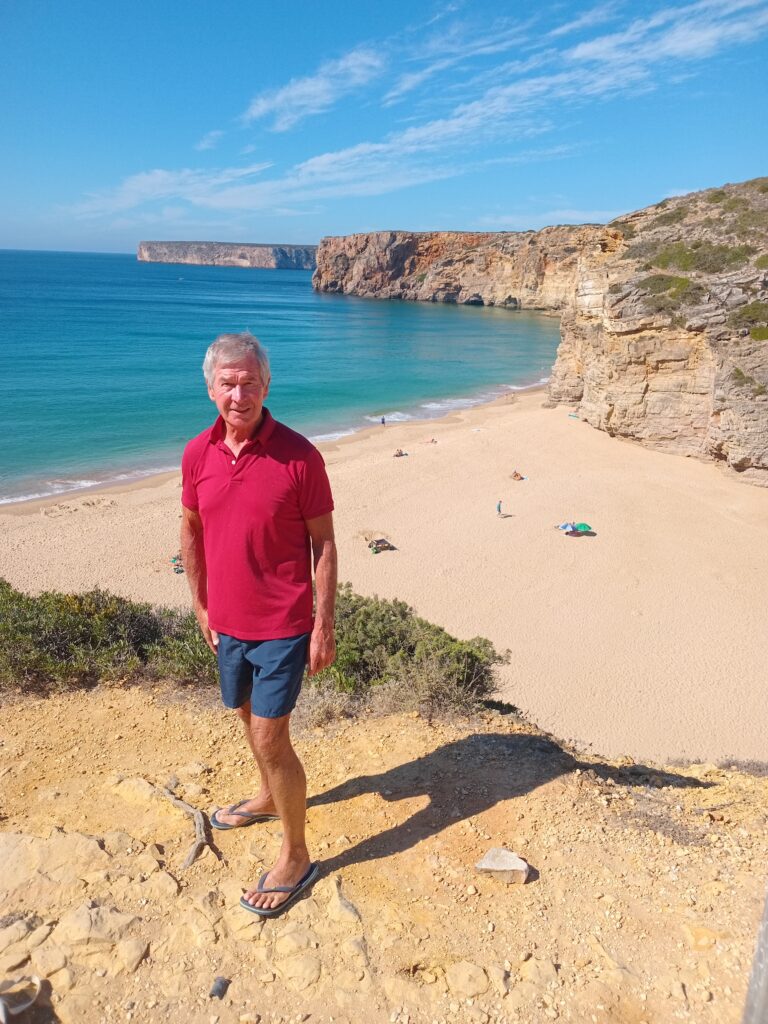
My final full day produced the best beach of all – Praia Beliche – on the southern-most tip of Portugal´s west coast, where the nearest town is Sagres. The beach has two distinct half-moon sections, each about 150 metres long and 50 metres wide. They are almost separated from one another by a jutting headland and both are surrounded by vertical cliffs 50 metres high; which means the only access to the beach is via a steep staircase which requires caution. On the day of my visit, the water was fully transparent and the sea at complete rest. One surprising feature was that the yellow sandstone layers of sedimentation in the cliffs were uniformly horizontal (don´t ask me why).
We are so used to concrete, steel and rectangular structures in our modern lives. Everything is organised, pre-ordained. In contrast, the microcosm of a beach is evidence that Nature is alive and moving. Sand dunes are blown into shape by the wind; and then blown into another shape by the next wind. The sea is always asking questions of the rocks, as the cliffs gaze down upon the show. There is movement, sound and smell. And there is history. My entire life span is no greater than the time it takes for just one wave to rise, form and fizzle onto a beach somewhere.
Travel Footnote: The total cost of my 2-week visit to Portugal was: Euros 2063 / USD 2307 / AUD 3303


Every storm eventually runs out of rain.