
Mark of Mallorca – Part 2
In Spanish, the word la masificación means “the widespread growth”. However, the locals use it in reference to the “avalanche of tourists” who come every summer to all parts of Spain – especially Mallorca. It´s an invasion which brings in a lot of money: but also creates massive congestion and various other problems. I began Day 1 of this continuation of my Mallorcan adventure in Deia; with Pollença on the island´s northern coastline as the day´s final destination. Along the way, I became enmeshed in and wholly disenchanted with la masificación. All advice prior to going to Mallorca had been that the north is “the most beautiful part” with lots of secluded coves with turquoise water. The Sierra de Tramuntana – the mountain range which runs along the north-western coast of Mallorca – was also said to hugely impressive with “surprisingly lush vegetation and near-vertical cliff faces of limestone rock”.
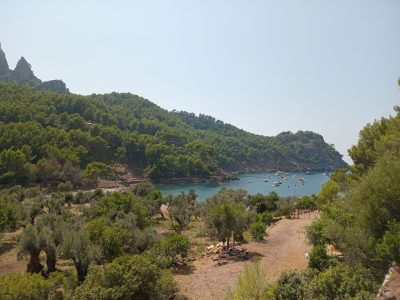
One of my principal goals on this day was to visit Cala (Cove) Tuent, which is near Soller and is listed by the Spanish Nauturist Federation (SNF) as clothing-optional. The hardest-to-get-to beaches are usually the ones where naturism is practised, because it´s too much effort for families to get there. Leaving Soller, you take the Ma-10 north; then just after Lake Gorg Blau take the Ma-2141 signposted to Cala Tuent and Sa Calobra. This last part of the journey – which took 40 minutes to cover just 14km – tested every scintilla of my driving skills. The road is perilously curvy as it inches up and over several mountainsides. Take your eye off the road for a second and you risk a collision: with the potential to plummet to the valley floor hundreds of metres below. And yet the rugged landscape with the sea in the distance constantly begs you to hazard a glance. Such a difficult drive would ensure Cala Tuent´s splendid isolation, I reasoned, as I held my nerve and pressed on.
Not so. On arrival, yes indeed the tiny cove is a spectacular creation of nature, but it was completely full of pleasure craft at anchor. Scores of them. The pebble-stone beach, about 100 metres long, was likewise crowded with families: and not a bare bottom in sight. I can only imagine the SNF´s recommendation of Cala Tuent was made decades ago when Mallorca was still in its bohemian period. More recently, Trip Advisor, Instagram and other social media outlets have commodified such “secluded” coves into “look at me” selfie destinations.
The problem (or solution, depending on your point of view) starts back in Soller, a town of no particular note. It has been connected to Palma de Mallorca by railway since 1912, and thence to the nearby Port of Soller by tram. It just so happens that this port is the nearest safe harbour to Cala Tuent and Sa Calobra, and others. So, when tourism exploded, an opportunity arose. An example is Vuelta Isla, a one-day excursion package which includes the train from Palma, then the tram to the port, then a boat/ferry trip to the secluded coves nearby. As part of this deal, Soller is promoted as a character-laden town (which it is not); while the port boasts a luxurious Mediterranean holiday lifestyle. I found the Port of Soller quite hideous. The once natural harbour is now packed with five times more commercial enterprises than could be tastefully accommodated. There are so many “buy me / rent me” aquatic offerings, plus souvenir shopes and ice-cream parlours, that it´s difficult to know where the land ends and the sea begins. Tourists aimlessly wander the streets, apparently in the belief that carrying a blue inflatable dolphin or wearing a blow-up ring around their waist affords them immunity to the rules of the road. The whole set-up is tacky beyond belief, but it works. The ferry boats and rental boats to Cala Tuent are full: the trams and trains are packed with wide-eyed tourists. And anyone who bothers driving to Cala Tuent must be nuts.
The tiny town of Fornalutx clings to a mountainside about 4km north of Soller. The stone houses with terracotta tiled rooves, plus the narrow, cobble-stone alleyways have propelled Fornalutx into the “oh, so beautiful” category. And, indeed, pretty it is. So much so that the local council has obviously decreed (judging from the works in progress) that all new buildings must conform precisely to the town´s established style. Stay on brand, everybody. There´s money to be made here.
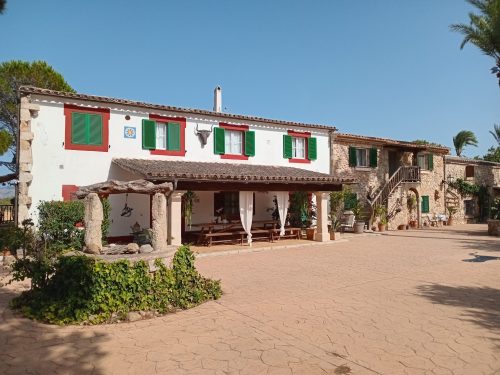
Thereafter the road through Lluc and eventually to Pollença was an enchanting mix of mountain vistas and thickly-wooded valleys. I had pre-booked four nights at Finca Can Cap de Bou, a restored 18th farmhouse located half-way between Pollença and Alcúdia. With space for 38 guests in lodgings of various sizes, each with a kitchenette, Finca Can Cap de Bou provides welcome relief from the summer tourist hustle, surrounded as it is entirely by pastures under agriculture. The place oozes rustic Spanish charm with its wooden window shutters and stone walls, while the swimming pool and tennis court add a modern touch. As a base from which to explore the northern half of Mallorca, Finca Can Cap de Bou is ideal: in part because you can deeply relax in silence at day´s end. By coincidence, the owner is Australian by birth.
A bright spot on my tour was a visit to a beach called Sa Cánova. From Alcúdia, take the Ma-12 to the south-eastern part of the Bay of Alcúdia, where you´ll find a road signposted to Son Serra de Marina. The beach starts at the far eastern end of this town. Remarkably, I was able to park right next to the entry point; and strangely the beach was sparsely populated. Sa Cánova´s impossibly crystalline water with occasional turquoise shades is banked by a white sand beach of a couple of kilometres in length. A striking mountain range provides the backdrop. The further you walk along the beach, the more naturist it becomes. On the return to Finca Can Cap de Bou, I came upon the seaside towns of Can Picafort and Port d´Alcúdia. Both have been badly hit by inflatable dolphin disease, so I kept on driving.
My Spanish friends had all advised: “Go early” to any place which is popular, to avoid the crowds. Nice in theory, but not always possible. Cala Mesquida on the north-eastern tip of Mallorca had been on my must-visit list since planning began; even though I was aware it´s popular. As circumstances would have it, I attempted a visit at around 11.00am. The one lane each way road to reach the outskirts of the Cala Mesquida township allows for no stopping, turning or parking. On entering the residential area of the town, I noticed I was in a slow-moving line of cars, all with the same intent. But every legitimate parking spot had already been taken, and every horizontal patch of ground also had a car on it. The anguished looks on the faces of drivers coming towards me foretold my plight. They had just finished a fruitless search and were now leaving the township; as I did about 10 minutes later. So, without being able to park, and without even being able to stop, I never did get to see Cala Mesquida. Such is la masificación. Some places are simply not able to be visited – if you don´t go early.
Conclusions: I visited five times more places in my 12-day Mallorca adventure than I have mentioned in these two blogs. I drove 900km around the island and loved every moment. That said, I don´t do crowds, so I wouldn´t revisit in July or August. Your preferred activity will dictate where and when you visit. My preference was coastal. If cycling or hiking or agri-tourism or golf is your thing, I saw plenty of encouraging signs in the interior. Over-commercialisation was apparent in some of the places I visited, making me feel a bit like a unit of income. But I guess everyone has the right to earn a living.


Every storm eventually runs out of rain.