
Lovely Lisbon – A Great Place To Meet
Over the past 3,000 years, Lisbon has been a popular port of call (and conquest) for Celts, Carthaginians, Phoenicians, Romans, Moors and even Christians on their way to the Crusades. In more recent centuries, the city was a vital port of re-supply in the colonial expansion plans of Europe´s great powers. So, when news came that two of my best friends from Australia would soon be in Portugal for the wedding of a nephew, a plan was hatched. Let´s do as the Romans and so many others had done – and meet in Lisbon. The fact that Lisbon´s history retreats so far into antiquity lent a poetic resonance to it being our meeting point, because my mate and I go back a long way too: 57 years to be exact. School together, then backpacking around Europe at age 21, followed by being the best man at his wedding. Which means the second of those two Australians in our Lisbon plan is his wife, with whom I´ve now had a
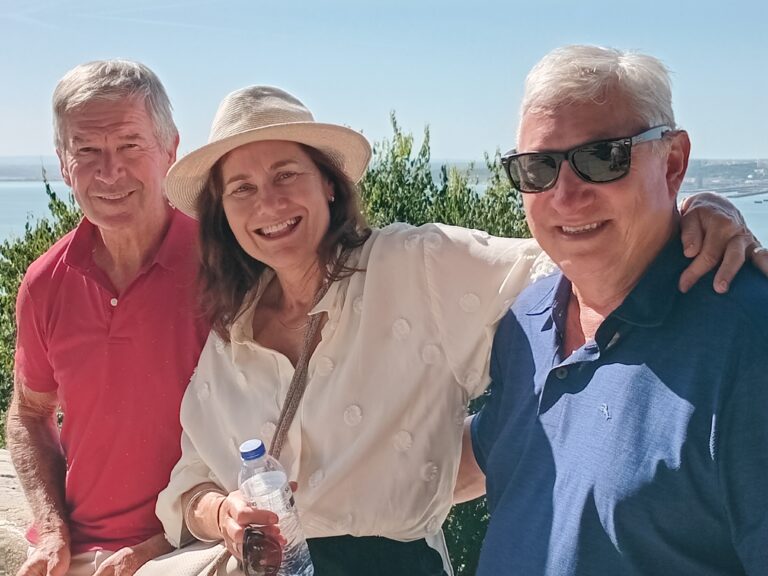
fabulous friendship for 40 years. But there´s more! Another Australian, who I´ve known for a mere 15 years, moved to Lisbon in 2024: and it was at his apartment that I spent the first five nights of my Portuguese peregrinations. Amazingly, despite having lived in Spain for 20 years, I had never been to Portugal.
“It seems kind of strange meeting here in Lisbon of all places,” said my long-term mate, as we were about to board a private, sunset cruise. “Then again, after everything we´ve done, maybe it´s not so odd?” he asked and answered. I saw us as two more world travellers passing through Lisbon: adding a bit to its history, and it to ours. As one of the world´s oldest continuously occupied cities, Lisbon is now home to about 650,000 people in its central area and a total of 3.35 million in its broader expanse.
My first surprise on walking the streets was the number of black African people. I hadn´t known anything about Portugal´s relationship with Angola, Mozambique, Guinea-Bissau and the Cape Verde archipelago. History shows that from the mid-1450s, as Portugal´s spice trade and slave trade grew, each of these African countries and the archipelago fell under Lisbon´s rule. Then, after hundred years of subjugation – more than 400 years in the case of Angola and Mozambique – each then gained its independence in 1975. Nowadays, those who were once colonially ruled contribute striking beauty and elegance to Lisbon: while the warm brown skin of many of their offspring is further evidence of Lisbon´s cultural diversity.
Lisbon sits alongside the Tagus River about 15km upstream from where the waterway empties into the Atlantic Ocean. At the point where Lisbon´s main bridge crosses the river, its width is only 1km (not bad for a river); however, the estuary then balloons in size to being 12.5km wide for the next several kilometres upstream. This creates the effect of it being more like a harbour than a river. Clearly, this made Lisbon a safe haven for the storm-weary ships of centuries past.
All visitors to Lisbon are warned about the seven hills of the city. (“Actually, we have eleven,” confessed our private tour guide, as we paced the streets, “but let´s not allow figures to spoil a good story”). Irrespective of their number, the sharply-rising hills give definition to Lisbon´s neighbourhoods, while the cobble-stone streets and sidewalks add to the city´s charm. As do the blue and yellow patterned tiles which adorn the façade of many buildings in the centre of town. These facades are so iconic to the city that the council only allows their restoration, not their removal. Apart from a few stand-out examples, if you´ve seen one European cathedral, you´ve seen ´em all. I say that somewhat in jest, but I found the Cathedral of Saint Mary Major, built in 1147 and thus Lisbon´s oldest church, to be unspectacular. Likewise, also on the tourist trail, the Thieves Market looked like any second-hand market anywhere.
In contrast, on top of Lisbon´s highest hill, the Castelo de São Jorge (Saint George´s Castle) gives a fascinating insight into the capital´s past. Human occupation of the castle hill dates to at least the 8th century BC, while the oldest fortifications on the site arose in the 2nd century BC. Those fortifications were occupied and rebuilt successively by Phoenicians, Carthaginians, Romans and Moors, before the conquest by the Portuguese in the 1147 Siege of Lisbon. Standing (as we did) on the castle´s parapets provides a full view of Lisbon and its modern port facilities; and its two multi-lane bridges; and its train stations; and its tall office blocks and hotels – none of which were there when the castle was built.
As ever, when trying to feel the history of a place, it´s often more what you can´t see than what you can see. From high on the parapet, we had to imagine a scene far below with wooden sailing vessels of yesteryear – the carracks, caravels and galleons with their canvas sails – arriving at the wharfs laden with cargo from the Far East; or just setting out on their journey to faraway places. Close your eyes and contemplate how those seven hills would look without trams running up and over them? Imagine, instead, donkeys and other beasts of burden slowly hauling food and water up those inclines. Consider also (if you care to) the human waste thrown onto those cobble-stone streets. And the accompanying disease.
Of course, as I now know, it all came crashing down in 1755 when a massive earthquake, followed hours later by a tsunami, destroyed 85% of the city´s structures and killed an estimated 40,000 Lisbon residents, out of a population of a bit over 200,000. It was a defining moment for the city and critics would comment that Lisbon never subsequently regained its world standing. But there´s reason to believe an economic revival is underway. Residential gentrification abounds. My 15-year Australian mate lives in the suburb of Penha de França, which used to be a working-class area but now boasts renovated apartments much sought after by expats. On which point, I was astounded by the frequency with which I heard that whining sound produced uniquely by women from the United States. Mainly young women, in this instance, students perhaps. I was also surprised at how full Lisbon was with tourists in late September – and at how young and pretty and handsome they all appeared, from various countries of the world. As a side note, our middle-age eyes estimated there to be three women in Lisbon for every one man.
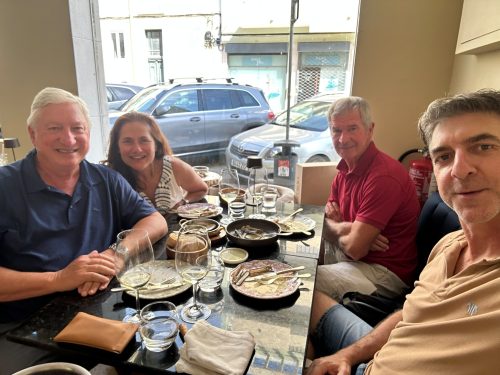
Our long lunch at a restaurant called Lisboa e Linda (Lisbon and Beautiful) in the upmarket suburb of Camp de Ourique put the visit into context. Lisbon, which has been a meeting point for humanity over hundreds of generations, was now playing brief host to four Australians, whose divergent paths had coincided. The moment and its effect on our (already) long friendships was there to savour. As was the meal – delicious.
Soon: Part Two of my peregrinations around Portugal


Every storm eventually runs out of rain.