
Mark of Mallorca – Part 1
Okay, so let´s get a few things straight, right from the start. Mallorca is pronounced: mai-yor-ka. It is the largest of the four Balaeric islands which lie in the Mediterranean Sea about 230km due east of Valencia. The Balaeric Islands are one of Spain´s 17 autonomous regions. Mallorca measures about 60 x 60km and has an overall permanent population of 980,000 (in 2024). Its capital is Palma de Mallorca, which has roughly 438,000 permanent inhabitants¸ 27% of whom are expats. I had never previously been to Mallorca: so, when a group of Australian friends said they would be renting a house for a week in Deià on the northern coast of Mallorca, I began planning my journey. This post will not be a definitive guide to Mallorca: rather, it will simply relate my experiences over a 12-day visit which commenced on July 21.
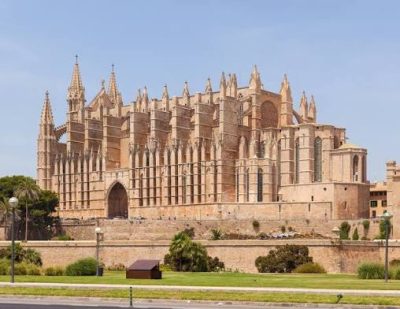
After driving from Tarragona to Barcelona, my car and I boarded the GNV ferry which I had booked through Direct Ferries at a cost of 149 euros. This included a bed in an all-male, four-bed cabin on the overnight outward leg and a reserved seat only on the daytime return leg. The buffet-style dinner on board elevated food at your average hospital cafeteria to gourmet level; however, the fact no-one else occupied my cabin compensated somewhat. The ferry disgorged us at Palma at 6.00am and my first few hours were spent wandering the old part of town, La Calatrava, with its narrow streets, stone archways and houses of timeless character. In this area one finds the building which dominates Palma´s skyline: the Cathedral-Basílica de Santa Maria de Mallorca. It was too early to go in, but I have since learned that construction began (on top of an existing mosque) in 1229 when the island was regained from muslim rule. Antonio Gaudi (of La Sagrada Familia fame) was invited in 1903 to oversee wide-ranging changes to the interior of the cathedral. As is my custom wherever I go, I then took the hop-on hop-off bus tour of the city at a cost of 13.50 euros for retirees and double that all others. It was a good example of the species with one stop – the Castell de Bellver – offering commanding views of the city.
Palma is famous for its big-boat international sailing regattas and as a destination for the world´s uber wealthy to step aboard their gigantic private yachts and motor cruisers. However, in addition to the elite level, the port of Palma has literally thousands of pleasure craft of all sizes crammed into a seemingly never-ending marina which stretches the entire length of the city´s foreshore.
On this now blistering hot day, the streets of Palma were bustling with mix of general commerce and the sound of many languages. In the centre, the Avinguda de Jaume III and the Passeig des Born reminded me of Barcelona´s Passeig de Gracia and Las Ramblas. All high-end Spanish and international fashion brands were present on either side of a tree-shaded central walkway with outdoor dining. Thousands of people were eager to spend their money: with the Mallorcins eager to receive it. A Spanish friend who lives in Palma took me to lunch at Celler Pagès (Restaurant Pagès), which specialises in Mallorcin food and is located just a few streets back from all the action. Delicious and well-priced at about 20 euros for main meals.
Getting into a car which had been baking close to the sun for six hours was a sensation which remained with me for the early part of the 50km drive to Colònia de Sant Jordi, the coastal town in the south-east corner of the island where I was to spend my first four Mallorcin nights at the Bluewater Hotel, which resides firmly but proudly in the “no-frills” category. My plan had been to use Sant Jordi as the stepping off point to several beaches identified by the Spanish Nauturist Federation (SNF) as clothing-optional. The first, Es Trenc, is accessed by leaving Sant Jordi on the road indicated as Ma-6040, then turning left after about 5km at the road signposted as leading to the Es Trenc parking. At a further 2km along you´ll encounter an open-air parking area, 200m from the water and charging 10 euros for the day. On reaching the beach, I could see that Es Trenc is perhaps 2.5km long, with fine white sand and crystalline water. However, there were many hundreds of beachgoers and just one chiringuito (beach café). Fortunately, after a shoreline walk of 750m away from the chiringuito, the madding crowd had given way to more far space and almost no bathing attire: and thus it remained along the rest of the beach. Mind you, scores of pleasure craft – some of them immense – lay at anchor just beyond the usual line of yellow buoys.
Heading north the following day, my intention was to visit Cala Varques (Cove Varques), which also appears on the SNF list of naturist beaches. En route, the cosy charm of towns such as Ses Salines, Santanyi and Calonge called out to me to stop and have a walk around. But I was on a mission. Alas, although Cala Varques appears as no different on the map to hundreds of Mallorca´s coves, I now know it was long ago posted on Trip Advisor and Instagram. As such, I couldn´t find a park within 1.5km of the entry point for the scorching 40-minute walk to the beach. Plus, the sight of so many twenty-somethings with their music, footballs and white complexions, convinced me there would be very little “naturist” about Cala Varques today; so I abandoned the plan. At least the town of Portocolum was pretty on the return leg.
More successful was my visit to another SNF beach, Platja des Caragols. Access is via the town of Ses Salines, then the Ma-6110 to Cap de Ses Salines which is the southern most tip of the island of Mallorca. At the iron gateway entrance to the lighthouse, you´ll see the start of a 25-minute walk along a flat dirt path to the beach. This time you´ll be greeted with an almost half-moon shaped beach of white sand and turquoise water – and a 50:50 ratio of textiles to nudists. But a warning: check the wind direction before you go. If it´s blowing strongly into Caragols, the place loses most of its appeal.
Time now to leave Colònia de Sant Jordi in the south and join my friends for three nights in Deià (day-ya) in the north. Along the way, as points of interest in Mallorca´s interior, Petra and Sineu had been recommended to me. Petra I found to be forgettable, while Sineu´s old part of town was well worth a stop. The famously beautiful town of Valldemossa, in the Serra de Tramuntana mountain range to the north of Palma, was being swarmed over by thousands of tourists when I arrived late afternoon. Think, ants on an anthill. So I drove straight through until a sign to the seaside Port of Valldemossa caught my eye. There began 20 agonising minutes of a near-vertical descent with blind, hair-pin turns every 30 seconds. When I mercifully reached the bottom, there was not a single parking spot to be found, thus leaving me with only one option: to immediately begin the ascent. It was, to be honest, quite an adventure. But not for the faint-hearted.
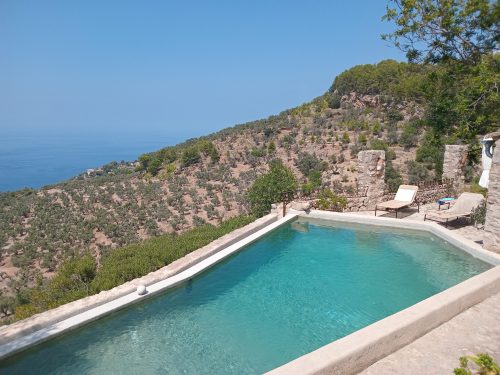
This part of Mallorca´s northern coastline is considered the most picturesque, where the ragged and mountainous coastline plunges into the blue sea below. Where each small cove is surrounded by rock walls of timeless age and character. Where ancient olive groves are held back by stone walls constructed hundreds, perhaps thousands of years ago. My friends had booked Finca son Ru, which began life as a 13th century monastery but is now a six-bedroom, four-bathroom luxury Spanish villa high on the hillside about 2km outside the village of Deià, whose grey stone homes with wrought iron balcony railings sit in idyllic harmony with the landscape. We were nine people in total. With its terracotta tiles, white interior walls, high ceiling with dark wooden beams, archways and rustic exterior, Finca son Ru is quintessentially Spanish. Not sure if the monks used the infinity pool much, but we certainly did. In its rural setting, the villa looks down upon a cala / cove into which enormous luxury cruisers gently eased each day. At drinks one late afternoon in Deià at La Residencia, a five-star Belmond Hotel, the presence of the musical empresario, Sir Andrew Lloyd Webber, at the table next to us added a touch of glitterati. Deià is beautiful, and it knows it.
By comparison, our day trip to Cala d´Or on the other side of the island for a 4-hour cruise on a 52-foot power boat seemed a step down in class. Nevertheless, Holls Boat Charter tried their hardest and we did swim into an impressively voluminous cave at one of the inlets we visited during the afternoon. But the joy was in coming back to Finca son Ru. At 2,500 euros a night, it would want to be.
Coming Soon: Mark of Mallorca – Part 2


Every storm eventually runs out of rain.