
Swim To Eat? Or, Eat To Swim?
We still haven´t decided what to call our monthly excursions to nearby towns where we swim and then go to lunch. Xina Swim-Lunch Tour? Aqua-gastro Adventure? Or perhaps just the plain truth….Swim, then Long Boozy Lunch. To be honest, the real motivation is just to have fun and to further develop friendships; and begin new ones. It matters little how far we swim or how well we eat. The benefit comes from just getting out there and doing something. So yesterday, 11 of us headed off to the town of Coma-ruga, about 25km north of Tarragona. (By the way, for those unaware, Xina is the name of the open-water swimming group of which I am a member. This post has more details).
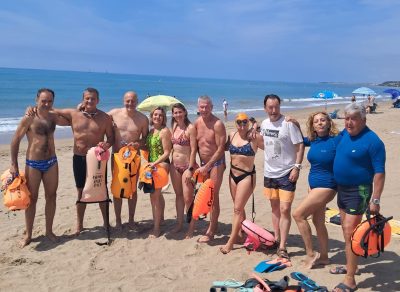
Our entry point to the water at 12 noon was just next to the marina at Coma-ruga. Our plan….vague. As is the case on all Spanish beaches, a line of yellow buoys sits about 125 metres offshore, with the buoys set at intervals of 75 metres. No watercraft at all is allowed to come closer to the beach than the buoys. We generally swim parallel to the line – just on the safe side. A few thunderstorms in recent days had taken the edge of the water´s clarity, but its temperature of 19 degrees was fine, as we set off with an agreed plan to swim five buoys and then discuss matters. The sun was bright and the sea calm; the first 400 metres easily accomplished, so we added another 400, by which point we felt we´d earned the right to have lunch. With the return leg, our total swim distance was just over 1.7 km. Very enjoyable and thoroughly lunch-deserving, I would say.
The first written reference to Coma-ruga appears in 1180, when the abbot of the nearby Monastery of Sant Cugat bequeathed the land to a local businessman. Many centuries later, in 1887, the railway came to Coma-ruga. During the 20th century, the train station became one of the most important railway intersections in the state of Catalunya and, as a result, a small neighbourhood developed around it. The name Coma-ruga has no specific meaning. However, the area became notable for its pond with hot springs which, in 1892, was declared by the Royal Academy of Medicine and Surgery of Barcelona to be of public interest for its health properties. In 1920, a hotel and spa complex was built near the pond. This started the urban development of Coma-ruga which saw the arrival of tourism in the 1960s and 70s.
It is standard procedure in Spanish restaurants to offer an a la carte menu and also a “menu del dia” (menu of the day) which has a set price. Within that set price, you choose one dish from each of a selection of primer platos (entrees) and segundo platos (main meal) and postres (deserts). The fixed price also includes one beer, wine or soft drink per person. You can of course order additional beer or wine at additional cost.
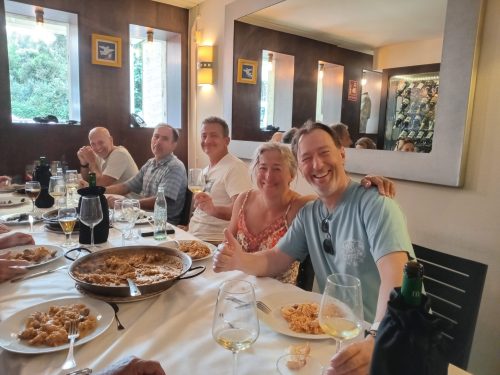
After changing from our wet swimming gear into our dry lunching gear, we wandered into the Restaurant Blau Marí (Blue Sea restaurant), which is about 500 metres from the beach. The interior of the restaurant struck me as being more up-market and elegant than seemed appropriate for the beachside setting: trying rather too hard with its excessively long-stemmed wine glasses, sterling silver settings and white linen napkins. My Spanish friends agreed. They told me it was a “quiero, no puedo” restaurant. The literal translation is “I want, I can´t”. But the colloquial understanding is that this is the type of restaurant to which people go when they want to see themselves as more sophisticated and classy than they actually are. So, for example, an 18-year old boy might take his new date to this restaurant; and by doing so blow away all his available cash for this month.
Often the food doesn´t match the décor. And so it was yesterday. At 32 euros (US $36 and $53 Australian) the menu del día offered in its primer plato a choice from: Iberian ham, mixed salad, cod fritters, calamari a la Romana, a caprese salad, and pan-fried octopus. My calamari was regulation okay, nothing more. There were three main meal offerings: seafood paella, arroz negro, and a seafood fideua. These all came in huge pans and the table served itself. I confined myself to the seafood paella, which was pleasant but will soon be lost to time. The standard deserts included crème brulee, tiramisu, profiteroles, lemon sorbet, etc.
Overall for the restaurant, 5 out of 10. But the day itself was a triumph. It involved risk, endeavour, laughter and exercise. We were living – not lounging.


Every storm eventually runs out of rain.